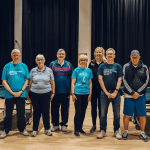

The project started in May 2025. The purpose of the project is to investigate how table tennis might enable people with Parkinson’s to manage their symptoms such as;
“Involuntary tremulous motion; lessened muscle power; passing from walking to running and a propensity to bend trunk forward.” (Parkinson’s 1817, Shaking Palsy)
Members were requested to complete a questionnaire covering date of diagnosis, date of starting table tennis; and to score symptoms such as tremor, ease of walking, shuffling, freezing , slowness in bodily movements from 1-5 (max=5)
During the course of the project, those members with symptoms described by Dr Parkinson received one-to-one table tennis training initially until they were able to play independently. Others enjoyed practising with the robot and playing matches; they also received one-to-one coaching. Non-PD players from my Ping Pong Parlour (PPP) were introduced to the group. Then the PPP group competed with the project group in March 2026.
Nine months after the project started, members were asked to comment on their table tennis skills, their level of enjoyment and to what extent their symptoms had improved
I had noticed that several members took small steps and did not swing their arms while walking. I made a train-track (video attached) for one particular person practising at home and he confirmed it was beneficial.
I have evidence showing improvements in co-ordination, footwork, social skills and speech. One person whose torso was bent double and needed a rollator as he was prone to falling, joined the project in November 2025. He had one-to-one concentrated practice weekly with his left hand holding on to the table. He started playing free hand in January 2026 and in March took part in a tournament. It is necessary to say that sustained improvement in physical and social behaviour is strongly associated with the rate of attendance. Deterioration in skills and body movements can be seen after a noticeable period of absence.
Batting with Parkinson’s is a small case study. Further research is needed to investigate the extent to which the improvements shown by members are linked to temporary chemical changes in the brain as a result of the following variables:
- Finding enjoyment in playing with others
- Seeing improvement in their skills and success
- Recognising the physical benefits
- The effects of background rhythmic sounds of bouncing ball
- Improvement in speech as a result of increased socialisation and opportunity to talk and be listened to.
Implication:
If table tennis is recognised as having a positive impact on the quality of life of people with the disease, then it would seem that introducing table tennis soon after diagnosis should be seen as complementing medication and slowing the deterioration of symptoms.
There is a need for more local clubs where people with Parkinson’s can have easy access and be integrated into the able-bodied table tennis community. Without easy access people rely on friends and public transport which can lead to erratic attendance.
Conclusion:
If we were to succeed in getting table tennis recommended for social prescription, a multi-centre research study is required. Recommendation could then be submitted to NICE as part of the Parkinson’s care pathway.
PETT editor’s note: This article describes observations from a small community project rather than a controlled clinical study. While participants have reported encouraging experiences, further research is needed to establish whether table tennis can directly improve Parkinson’s symptoms or affect disease progression.We welcome news of research on Parkinson’s and table tennis. See our web page for links to other relevant research and evidence. Find a group near you here.